How a single block became a row of townhouses on the Old Market Square in Chojnice
Townhouses once stood here. The war destroyed them. A concrete block took their place. Here is how a later transformation gave the Old Market Square in Chojnice back its historic character.

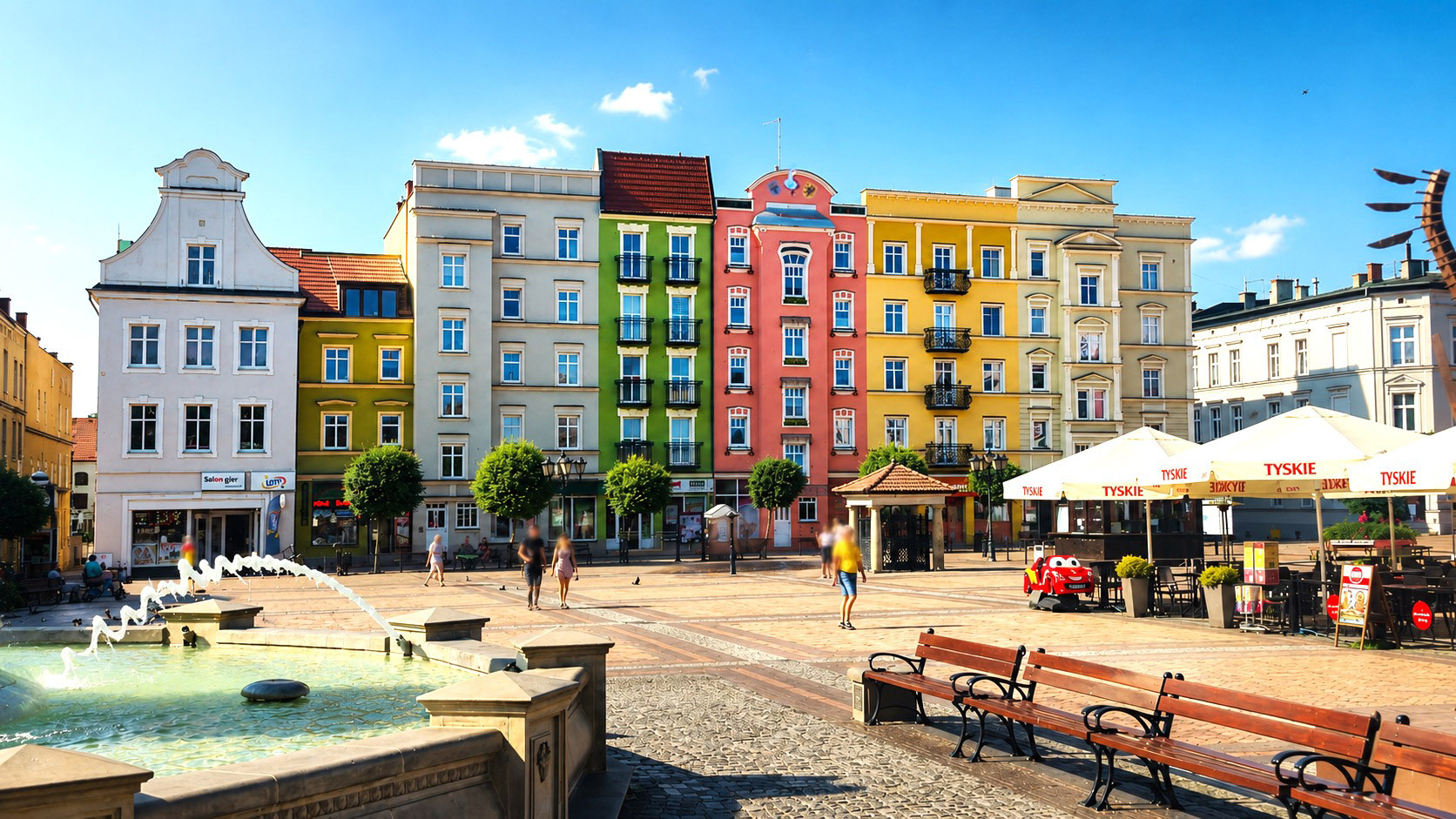
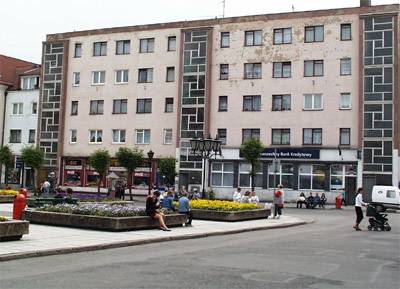 Before
After
Before
After
Townhouses destroyed by the war
The Old Market Square in Chojnice has medieval roots — its urban layout was laid out in the 14th century, and it is this layout that still gives the square the character we recognise in its surrounding frontages today. The southern side of the square, where the building at 11/13 now stands, had for centuries been occupied by a row of narrow, individual townhouses.
In February 1945, wartime fires destroyed much of the southern frontage. Only the townhouses on the northern side of the square survived. The historic houses at 11/13 ceased to exist, leaving a gap in the market frontage for years to come.
A communist-era block
A post-war apartment building rose on the site of the destroyed townhouses — a single modernist block with a repetitive window rhythm and a flat facade stripped of detail. While its height and building line matched the historic scale, its continuous, monotonous frontage broke with the rhythm the market square had held since the Middle Ages.
In a town like Chojnice, the market square is defined not only by the open space but above all by the walls that enclose it. When one of those walls was occupied by a single uniform volume, the space lost its rhythm and human scale — even though the building's height itself was preserved.
Regeneration: restoring the scale of townhouses
Andrzej Ciemiński's design did not reconstruct the destroyed townhouses, nor did it change the structure or volume of the existing block. The entire transformation took place on the facade. The uniform front was rearticulated as a sequence of separate townhouses — as if several independent buildings, similar to those the war had destroyed, stood side by side on this spot.
It is a purely architectural move, yet with a real urban effect: it restores the natural grain of the market frontage. The passer-by no longer reads one long block but a rhythm of gaps and individual facades — close to what once stood here before the war took it away.
Colour, rhythm and roofline
Each "townhouse" was given its own facade colour, its own window rhythm and a distinct crowning element — from a triangular gable, through a parapet, to a cornice with classical detailing. Differences in colour and roofline height let us read neighbouring sections as separate houses, even though they share one wall.
It is the detail that makes the whole illusion convincing. Pilasters, window surrounds, cornices and varied gables draw on the language of the town's bourgeois architecture. Without them the division would be mere painted stripes; with them, it becomes a genuine restoration of the square's historic character.
An award and a lesson in urban scale
The transformation was completed in 2000 and the project was nominated for Poland's Modernisation of the Year 2000 award. Today, for many residents and visitors, the colourful townhouses are simply a natural part of the square — few remember the war, the communist-era block, or the journey this site took before reaching its present form.
The project shows that regeneration need not mean demolition, nor a faithful reconstruction of what history destroyed beyond recovery. Sometimes it is enough to read a place carefully and give it back the scale and rhythm it was missing. It is the same way of thinking we bring to contemporary refurbishments and extensions — starting from how a building speaks to its surroundings.