What does it cost to take a plot out of agricultural use? Usually nothing
The fee for releasing land from agricultural production often puts buyers off a rural plot. For a typical single-family house it never arises.
- Land use and soil class in the land registeronly the categories listed in Art. 11 need an exclusion decision
- Land designation in the plan or building-conditions decisionthis is what settles whether a house can be built at all
- The decision permitting exclusion from productionneeded before non-agricultural use of the land begins
- The charge and the annual feesArt. 12a waives them up to 0.05 ha for a single-family house
Two different matters under one word
In everyday Polish conversation the word “odrolnienie” covers two separate procedures. The first concerns the designated use of the land and answers the question of whether a house may be built there at all. This is settled by the local spatial development plan, or in its absence by a building-conditions decision.
The second is the release of land from agricultural production — a decision of the district authority that allows work to begin on agricultural land. It applies to land that already carries a building designation.
The question about cost almost always concerns the second procedure, while the barrier that actually stops projects lies in the first. We covered it in the article on what the municipal general plan means for a plot. This text is about money alone: when charges arise and how much they are.
When a release decision is required
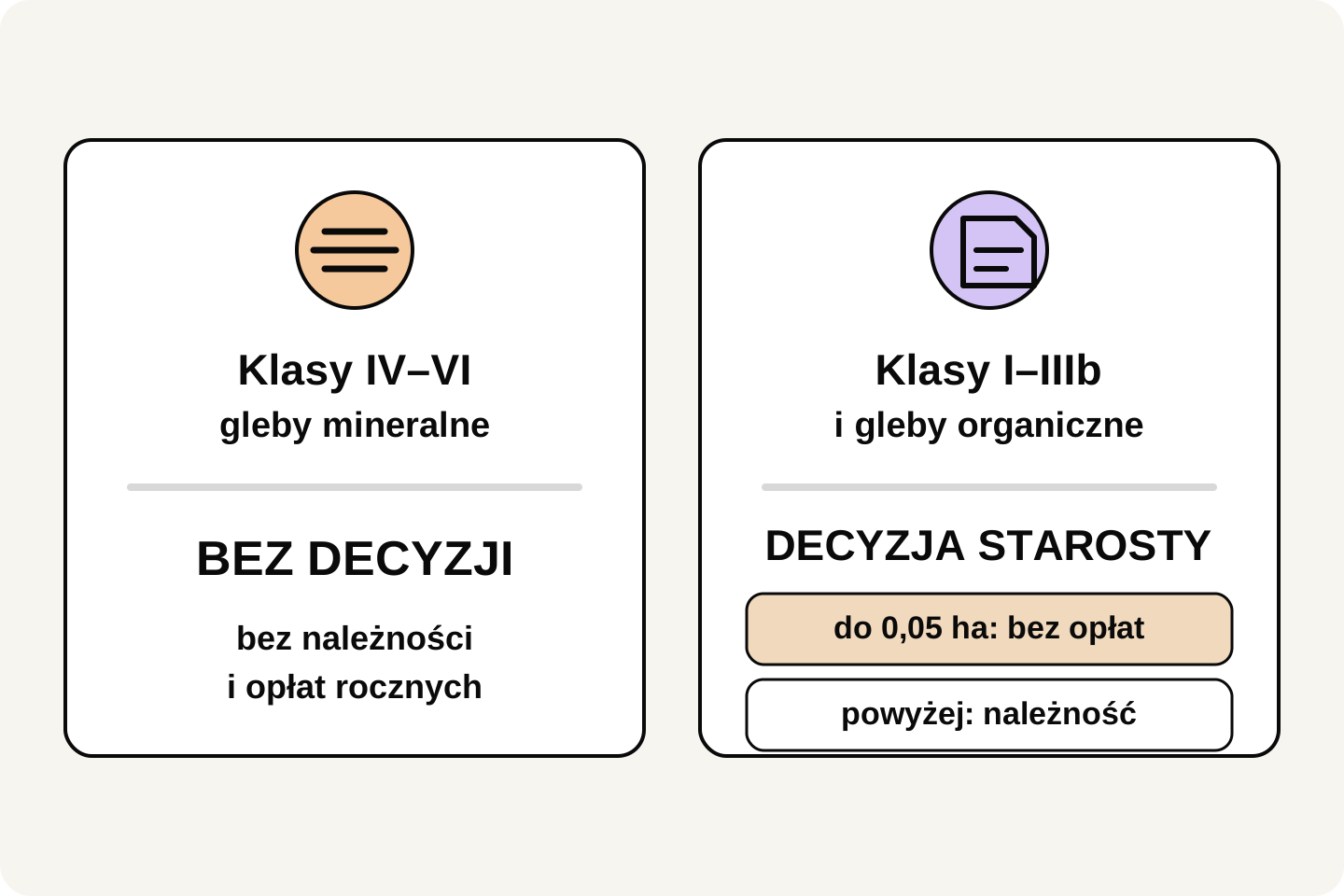
The act on the protection of agricultural and forest land lists the land covered by the obligation: agricultural land of classes I, II, III, IIIa and IIIb formed from mineral and organic soils, and land of classes IV, IVa, IVb, V and VI formed from organic soils.
That list leaves a case which occurs often in practice: classes IV, V and VI formed from mineral soils do not go through the procedure at all. No decision, no charge, no annual fees.
Light soils prevail on the outwash plain around Chojnice, so this variant appears here regularly. What settles the matter, however, is not the general character of the area but the land-register extract for the specific plot. Whether a soil is of mineral or organic origin does not always follow directly from the register symbol and is sometimes determined by the district authority.
The exemption covers 0.05 hectare per building
For land that does require a decision, the act grants relief from the money, not from the procedure. The obligation to pay the one-off charge and the annual fees does not apply to a release for housing purposes of up to 0.05 ha for a single-family building, or up to 0.02 ha per dwelling in a multi-family building.
0.05 ha is 500 m², counted not as the floor area of the house but as the area of land leaving agricultural use: the building footprint together with the paved and permanently occupied ground beside it.
A typical single-family house fits within that threshold with room to spare. The decision still has to be obtained, but no bill follows.
| Agricultural land | Release decision | Charge and annual fees |
|---|---|---|
| classes I, II, III, IIIa, IIIb — mineral and organic soils | required | none up to 0.05 ha for a single-family building |
| classes IV, IVa, IVb, V, VI — organic soils | required | none up to 0.05 ha for a single-family building |
| classes IV, IVa, IVb, V, VI — mineral soils | not required | none arise |
Where the cost actually appears
Above the threshold the conversation turns to money. A large footprint, a detached garage and wide paved surfaces can push the released area beyond 500 m². Authorities differ in practice here: some district offices exempt the first 0.05 ha and charge for the excess, others treat an overrun differently. The question is worth putting to the district office for the plot, ideally before buying it.
The charge itself depends on the soil class and is reduced by the market value of the land being released; for the following ten years annual fees of 10% of the charge are collected. On protected classes, with a large release, these are amounts that change the budget of the project.
A separate case is work that began without the required decision. The act then provides for a charge of twice the standard amount. If the land was designated for non-agricultural use in the local plan and was released without a decision, the decision is issued ex officio and the charge is increased by 10%.
What actually decides the plot
The soil class and the release charge rarely settle whether a house will be built. That is settled by the designated use of the land: the local plan or a building-conditions decision, and once the municipal general plan takes effect, also whether the plot lies within an infill development area.
This order matters when viewing plots. The soil class is visible in the register straight away, while the designated use requires checking municipal documents — and it is usually the one that decides. We described the route to a building-conditions decision separately.
The draft general plan for the rural municipality of Chojnice was placed on public display in spring 2026. The current status of the plan and the boundaries of the infill development areas are shown in the municipal planning register — for a rural plot that is the first thing to check today, before the question of soil class.
Releasing land from agricultural use — short answers
Are “odrolnienie” and release from production the same thing?
In everyday speech yes, formally they are two matters. Changing the designation of agricultural land to non-agricultural use happens in the local spatial development plan, and in its absence a building-conditions decision opens the way to building. Release from agricultural production is a later decision of the district authority, concerning land that already carries a building designation.
What does a release above 0.05 ha cost?
The charge is set according to the rate for the soil class and reduced by the market value of the land released; for the following ten years annual fees of 10% of the charge are collected. The amount therefore depends on the class, the area and local land prices. The calculation for a specific plot comes from the district office.
Does the soil class decide whether building is possible?
No. The class affects whether a release decision is needed and whether a charge arises. Whether a house may stand there is settled by the designated use in the local plan or a building-conditions decision, and once the general plan takes effect, also by whether the plot lies within an infill development area.
What follows from starting work without a release decision?
The act provides for a charge of twice the standard amount for a release carried out contrary to the regulations. If the land was designated for non-agricultural use in the local plan and was released without a decision, the district authority issues the decision ex officio and increases the charge by 10%.