Can a farmer build a house outside the infill development area? No
A farmer with an above-average holding could get building conditions in open fields. Once the general plan takes effect, that exemption works only inside the infill development area.

- The status of the municipal general planuntil it enters into force, the infill-area condition does not apply
- Whether the plot lies in the infill development areaArt. 61(1)(1a) — the farmer’s exemption does not waive this one
- Farm size against the municipal averageArt. 61(4) then waives the good-neighbour condition only
- A new house or a building that already standsrebuilding, extension and adding a storey are possible outside the area under Art. 61(1a)
The farmer’s exemption removes one condition, not two
Article 61(1) of the Polish spatial planning act lists the conditions a building-conditions decision must meet together. The first two read as follows: point 1 — at least one neighbouring plot accessible from the same public road is built up in a way that allows requirements for the new development to be determined; point 1a — the land lies within an infill development area.
Paragraph 4 of the same article reads: “The provisions of paragraph 1 point 1 do not apply to farm-homestead building where the area of the agricultural holding connected with that building exceeds the average area of an agricultural holding in the municipality concerned.”
The cross-reference points to point 1. Not to point 1a. A farmer with an above-average holding therefore need not demonstrate good neighbourhood — and for years that was enough, because as long as a municipality had no general plan, the condition in point 1a did not apply at all. A house could stand in open fields, and regularly did.
A broader reading of the provision circulates: that it also releases the farmer from the infill development area. The wording does not support it.
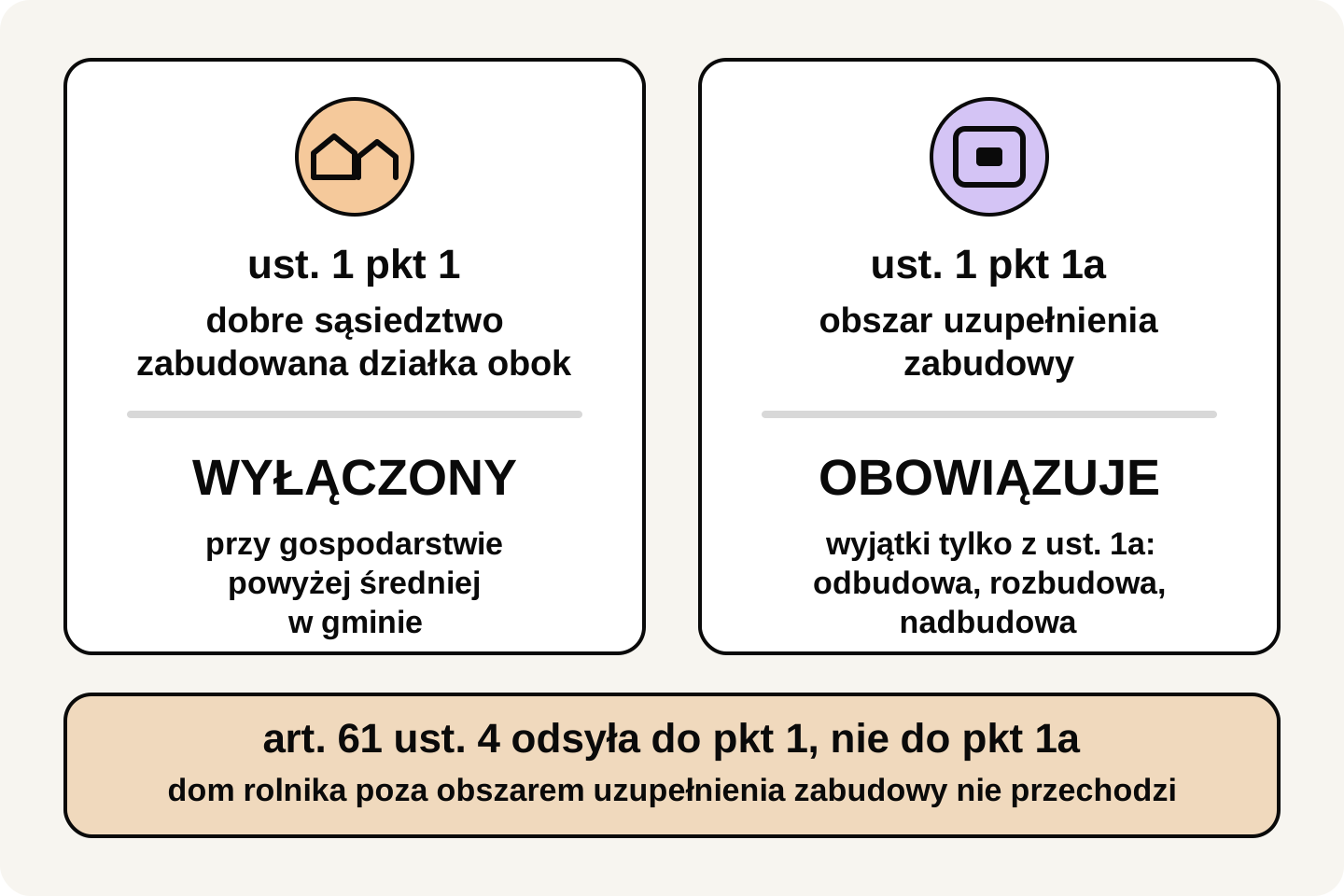
There are three exceptions to the infill area
The act lists them in Article 61(1a): projects that change the use of land other than by erecting a structure, building works consisting of rebuilding, extension or the addition of a storey, and projects located on closed areas. Farm-homestead building is not on that list.
Paragraph 3 stands separately and waives the conditions in points 1–2, the infill area included, for eleven categories of structures. The one that concerns farmers is point 7: farm outbuildings with a built-up area of up to 35 m², intended solely for agricultural purposes on an existing agricultural holding.
That produces a difference which usually comes as a surprise in a conversation about a plot: a canopy or a small outbuilding may stand outside the infill development area, while the house beside it may not.
| Provision | What it waives | Does it open a house outside the infill area |
|---|---|---|
| Art. 61(4) — farm-homestead building on a farm above the municipal average | the good-neighbour condition (para. 1 pt 1) | no |
| Art. 61(1a) — rebuilding, extension, adding a storey | the infill-area condition (para. 1 pt 1a) | only where a building already stands |
| Art. 61(3)(7) — a farm outbuilding up to 35 m² on an existing farm | the conditions in para. 1 pts 1–2, the infill area included | yes, but it does not cover a dwelling |
How this looks in the municipalities around Chojnice
Czersk adopted its general plan on 26 May 2026, the town of Chojnice on 22 June, and the rural municipality of Chojnice on 13 August — its plan has been in force since 4 September. Brusy is still running the procedure, although the statutory deadline passed on 31 August 2026.
Infill development areas cover 638.91 ha in Czersk, that is 1.68% of the area under the plan, and 857.32 ha or 1.87% in the rural municipality of Chojnice. The Brusy draft gives 531.04 ha and 1.33%. In the town of Chojnice, where development is compact, the figure is 27.64%.
These percentages cannot be read onto a particular property — in rural municipalities the total area includes forests, lakes and fields. They do show the scale: most farmland stays outside the boundary, and with it most of the places where new homesteads used to appear. We described how to check where a given plot falls in the article on the municipal general plan.
From 20 September 2026, a second lock
The act of 4 December 2025 amending the building act adds a definition to Article 3: farm-homestead building means “single-family residential buildings and farm or livestock structures connected with agricultural production within an existing homestead plot, on family agricultural, livestock or horticultural holdings and on forest holdings”. This part of the amendment enters into force on 20 September 2026.
Until now the building act carried no definition of its own and authorities reached for the one in the technical-conditions regulation. The new definition contains a word the old one lacks: existing.
Farm-homestead building is therefore a building added to a homestead that already functions. Marking out a new homestead on arable land stops fitting the definition. The provision is fresh and administrative practice has yet to settle, but the direction matches what the general plan does: scattered development stops being a shortcut.
What this means when you are looking at land
The order of checks on a rural plot does not change: first the local plan, in its absence the general plan and the boundary of the infill development area, and only at the end the soil class and the cost of release from agricultural production. For a single-family house that last cost usually never arises, so it is not the thing to ask about first.
Farmer status and the size of the holding still matter, but they answer for one condition out of six, not for entry beyond the development area. The line “you are a farmer, so you will build” describes the situation before the general plan.
If a municipality has not finished its procedure, the date matters. Proceedings opened before the general plan enters into force are as a rule conducted under the previous rules, and a decision already issued keeps its validity — from 1 January 2026 for five years. What such an application contains and how long it takes we described in the guide to building conditions step by step.
Farm-homestead building — short answers
Does the exemption in Article 61(4) allow building outside the infill development area?
No. The provision waives paragraph 1 point 1, that is the good-neighbour condition. The requirement that the land lie within an infill development area is set out in paragraph 1 point 1a and stays in force. The exceptions to it are listed in paragraph 1a, and farm-homestead building is not among them.
Can a farmer put up an outbuilding outside the infill development area?
Yes, if the project falls under Article 61(3)(7): a farm outbuilding with a built-up area of up to 35 m², intended solely for agricultural purposes on an existing agricultural holding. That provision waives the conditions in points 1–2, the area requirement included. It does not cover a dwelling.
What does “within an existing homestead plot” mean?
That from 20 September 2026 farm-homestead building, as the building act understands it, means buildings added to a homestead that already exists. The definition does not cover marking out a new homestead on land not built on so far. The basis is Article 3(25) of the building act as amended by the act of 4 December 2025.
What happens to a building-conditions decision obtained before the general plan was adopted?
A decision issued earlier keeps its validity, and decisions issued from 1 January 2026 are valid for five years from the day they become final. Proceedings opened before the general plan enters into force are as a rule conducted under the previous rules.